Weather Patterns Reshaping Probability Calculations for Outdoor Athletic Competitions and Their Digital Tracking Methods
Written by Anna Lange · Jul 26, 2026

Weather Patterns Reshaping Probability Calculations for Outdoor Athletic Competitions and Their Digital Tracking Methods
Changing Climates and Performance Metrics
Weather patterns have long influenced outdoor athletic events, yet recent shifts in global climate data have prompted researchers to revise how they calculate probabilities for outcomes in competitions such as tennis tournaments, marathon races, and cricket matches, and digital systems now integrate real-time meteorological inputs to adjust those models on the fly.
Studies from institutions like the Australian Bureau of Meteorology show that increased variability in temperature and precipitation alters player endurance and equipment behavior in measurable ways, while organizations track these variables through networks of sensors deployed at venues worldwide.
Digital Integration of Meteorological Data
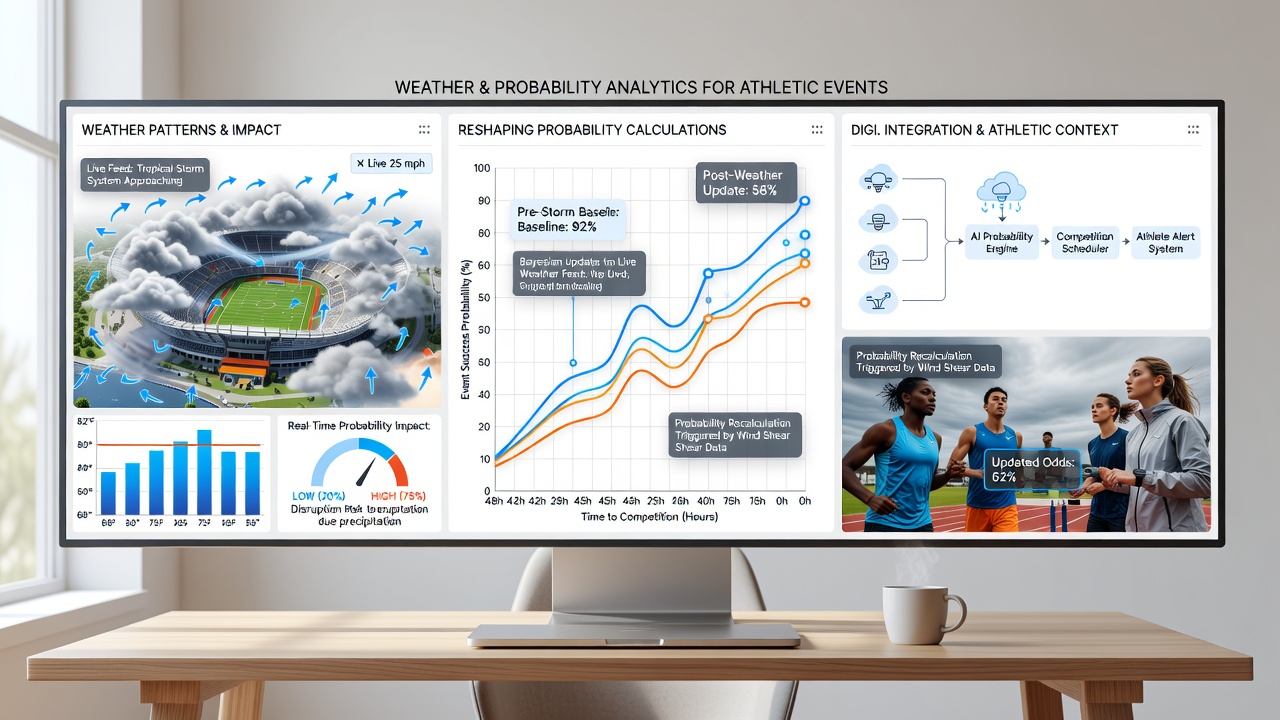
Teams responsible for event planning rely on platforms that combine satellite feeds with ground-based instruments to forecast conditions hours or days ahead, and these systems feed into probability engines that recalibrate expected results for athletes based on factors like wind speed affecting serve accuracy or humidity impacting ball trajectory in cricket.
During July 2026, multiple international events demonstrated this approach when sudden rainfall patterns in Europe forced organizers to update performance projections for several track and field athletes mid-competition, using algorithms that accounted for surface moisture levels and temperature drops.
Case Examples Across Sports
Take tennis matches played on grass or clay courts where prolonged dry spells followed by heavy downpours change court speeds dramatically, prompting analysts to rerun statistical models that predict point-win percentages for individual players under those revised conditions. Observers note that similar adjustments occur in golf tournaments where gusts above certain thresholds reduce driving distances, leading digital dashboards to display updated probability distributions for each hole.
Marathon organizers in urban settings now employ wearable devices paired with local weather stations to monitor core body temperatures alongside ambient heat indices, allowing real-time shifts in hydration and pacing recommendations that directly influence finish-time probabilities calculated by event software.
Technological Tools Driving Updates
Software suites developed by research consortia pull data from sources including the European Centre for Medium-Range Weather Forecasts and feed it into machine learning frameworks that have learned historical correlations between specific weather events and competition results across decades of archived data. These frameworks generate scenario-based outputs that event officials review before adjusting schedules or safety protocols.
One study published through university collaborations in Canada highlighted how wind direction changes during rowing regattas required recalibration of lane advantage probabilities, with sensors on boats transmitting live telemetry that updated central models every few minutes.
Broader Implications for Event Management
Event coordinators increasingly view weather not as an external variable but as an integral component of their operational models, and this perspective has led to investments in redundant data streams that prevent single-point failures during sudden atmospheric shifts. Data from the National Oceanic and Atmospheric Administration supports the observation that frequency of extreme precipitation events has risen in many regions, necessitating more frequent model refreshes than in previous decades.
Those who manage large-scale competitions now schedule regular audits of their probability algorithms to ensure they incorporate the latest climatological trends, while athletes and support staff access simplified versions of these outputs through mobile interfaces that highlight risk thresholds for heat stress or visibility issues.
Conclusion
Digital tracking methods continue to evolve alongside advancing meteorological science, creating tighter feedback loops between observed weather conditions and recalculated performance probabilities for outdoor athletic competitions, and stakeholders across regions maintain these systems through ongoing collaboration with government agencies and academic researchers to keep pace with environmental changes.